
Persistent shoulder pain that worsens with overhead movements, an elbow that becomes painful when lifting everyday items, or hip discomfort that increases with prolonged sitting are common reasons people ask about injection options. Two treatments often discussed in these situations are cortisone injections and PRP (platelet-rich plasma) therapy.
Both can ease pain linked to subacromial bursitis, trochanteric bursitis, tennis elbow and golfer’s elbow, but they work in different ways and suit different stages of an injury, with a different price tag attached. Here’s a practical look at PRP vs cortisone injections, so you know what each one involves before deciding which fits your situation.
What Is a Cortisone Injection?
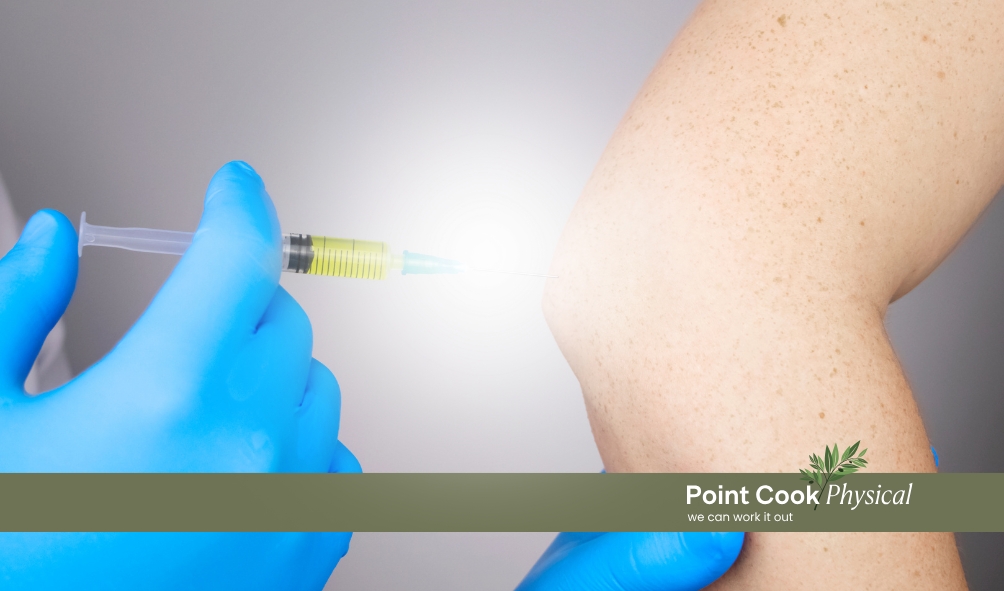
Cortisone is a corticosteroid, a manufactured version of the anti-inflammatory hormones your body produces naturally. Injected into or around an irritated bursa or tendon, it calms the local inflammatory response driving your pain. For bursitis, it’s typically delivered straight into the bursa under ultrasound guidance so the needle lands exactly where it needs to. For tennis elbow and golfer’s elbow, it’s injected around the affected tendon origin near the elbow joint.
The appointment itself is quick. After a brief assessment and ultrasound check, the skin is cleaned, a local anaesthetic numbs the area, and the cortisone goes in. Most people are in and out within 20 minutes. Some discomfort is normal, and a small number of patients get a short flare of increased pain for a day or two afterwards, sometimes called a steroid flare, before things settle and improve.
What Is a PRP Injection?
PRP injections use a concentrated dose of your own platelets to encourage injured tissue to repair itself. Blood is drawn from your arm, spun in a centrifuge to separate out the platelet-rich layer, then injected back into the site of injury under ultrasound guidance. That platelet layer carries growth factors involved in tissue healing, which is the mechanism PRP is trying to switch on.
Because the goal is to trigger a healing response rather than suppress inflammation, a PRP appointment takes longer than a cortisone one, usually 30 to 60 minutes once the blood draw and processing time are factored in. It’s also more uncomfortable, both during the injection and for several days afterwards. Anti-inflammatory medication is often discouraged in the days after PRP, since dampening inflammation can work against what the treatment is trying to achieve.
What Each Injection Costs in Australia
Cortisone is generally the less expensive option compared with PRP. In Australia, the cost of a cortisone injection can vary depending on the provider, the type of injection, and whether ultrasound guidance is used. Some patients may receive a Medicare rebate for eligible medical consultations or procedures performed by a medical practitioner, but out-of-pocket costs will depend on the referral pathway, provider, and individual circumstances.
PRP is generally more expensive than cortisone, largely due to the additional preparation and blood-processing steps involved. In Australia, PRP injections are typically not covered by Medicare, meaning patients usually need to consider the out-of-pocket cost. Some private health insurers may provide partial cover depending on the level of extras included in a policy, so it is worth checking with your provider before proceeding.
How Each Treatment Performs for Your Specific Injury
Success rates vary a lot depending on which condition is being treated and how long it’s been going on. The pattern across the research is fairly consistent: cortisone tends to act faster, and PRP tends to hold up better over time, particularly for tendon problems rather than straightforward inflammatory bursitis.
Subacromial Bursitis (Shoulder)
Cortisone is usually the first injection tried for subacromial bursitis. Research suggests somewhere between 60% and 90% of patients get meaningful short-term relief, sometimes within days. That relief can last weeks to months, but symptoms often return if the underlying biomechanics, such as poor shoulder blade control or rotator cuff weakness, aren’t addressed alongside the injection. PRP’s evidence base for shoulder bursitis is more mixed. It tends to perform best when the bursitis sits alongside rotator cuff tendinopathy or shoulder impingement rather than as an isolated issue, and is more often considered once cortisone hasn’t produced lasting results.
Shoulder pain linked to sport tends to respond better when an injection is paired with a structured rehabilitation plan for the underlying sports injury rather than used in isolation.
Trochanteric Bursitis (Hip)
The same pattern shows up at the hip. Cortisone is typically the first injection offered for trochanteric bursitis, with around 60% to 80% of patients reporting relief. Some need a repeat injection within months. PRP is increasingly used for trochanteric bursitis that keeps recurring, particularly when gluteal tendon degeneration is part of the picture rather than bursitis on its own. Some research has found PRP outperforming cortisone for chronic, severe cases at longer follow-up.
If hip pain keeps coming back after a cortisone injection, that’s usually the point where PRP becomes worth raising with your treating practitioner.
Tennis Elbow and Golfer’s Elbow
This is where the evidence for PRP is currently strongest. Research, including systematic reviews and meta-analyses of clinical trials involving people with tennis elbow, suggests that cortisone injections may provide better short-term pain relief, particularly in the first few months. However, PRP appears to offer better longer-term outcomes for some patients, with improvements in pain and function becoming more noticeable over time. The evidence for golfer’s elbow is more limited, but early research suggests a similar pattern may apply.
For tennis elbow and golfer’s elbow, the choice often comes down to timeline: cortisone if you need pain settled quickly for a return to work or sport, PRP if you’re dealing with a chronic, recurring problem and can tolerate a slower path toward improvement.
The Downsides Worth Knowing
Cortisone’s Drawbacks
Cortisone doesn’t directly repair tissue. It quiets inflammation, which eases pain, but it doesn’t address whatever caused the bursitis or tendon irritation in the first place. Repeated injections into a tendon have been linked to weakening of that tissue over time, which is why most practitioners limit how often they’ll inject the same tendon.
A temporary pain flare in the days after the injection is possible, along with skin thinning or discolouration near the injection site. Symptoms can also return once the medication wears off.
PRP’s Drawbacks
Cost is the most obvious downside of PRP, given it usually runs several times higher than cortisone with no Medicare support. The procedure is also more uncomfortable, both from the blood draw and the injection itself, and post-injection soreness lasting a few days is common. Results tend to show up more slowly and less predictably than with cortisone. Preparation methods also vary between providers. Platelet concentration isn’t standardised across clinics, which makes it harder to compare outcomes between different studies or providers.
When an Injection Might Not Be the Right First Step
Neither cortisone nor PRP corrects a movement pattern or a training load that’s been ramped up too quickly, and these are often the real drivers behind bursitis and elbow tendon pain. Skipping a proper assessment of shoulder, hip or elbow mechanics before injecting can leave that underlying cause free to keep reloading the area, even once the injection eases the symptom.
For mild or recent-onset symptoms, a course of physiotherapy or osteopathy aimed at correcting the contributing movement pattern is often tried first. It may be all that’s needed.
Commonly Asked Questions About
Is PRP better than cortisone for tennis elbow?
It depends on timeline. Cortisone generally gives faster relief in the first one to two months. Research suggests PRP produces better pain and function scores from around six months onward. Many practitioners use cortisone for an acute flare and consider PRP if tennis elbow becomes chronic or keeps recurring.
How much does a PRP injection cost compared to cortisone in Australia?
Cortisone injections typically cost $150 to $600 depending on whether ultrasound guidance is used, with partial Medicare rebates sometimes available on the consultation. PRP usually costs $500 to $2,000 per injection and isn’t covered by Medicare, so it sits entirely as an out-of-pocket expense for most patients.
Does cortisone weaken tendons over time?
Repeated cortisone injections into the same tendon have been linked to weakening of that tissue, which is one reason practitioners limit how often they’ll repeat the injection. This matters more for tendon conditions like tennis elbow than for bursitis, where the injection targets the bursa rather than the tendon itself.
Can PRP help with subacromial or trochanteric bursitis?
PRP’s evidence for bursitis is more mixed than for tendon conditions. It tends to help most when bursitis occurs alongside rotator cuff tendinopathy at the shoulder, or gluteal tendon changes at the hip, rather than as an isolated bursitis. Cortisone is usually tried first for straightforward, acute bursitis.
Do I need an injection at all, or should I try physiotherapy first?
Not always. Many cases of bursitis and elbow tendon pain improve with an assessment-led rehabilitation plan addressing the load or movement pattern driving the problem, particularly when symptoms are recent or mild. Injections tend to become more relevant when pain is severe, persistent, or hasn’t responded to a structured rehab approach.
Final Thoughts
There’s no single right answer to the PRP vs cortisone question. Cortisone suits acute flares and situations where quick relief is needed to get back into rehab. PRP suits chronic, recurring cases, particularly tendon-related ones like tennis elbow and golfer’s elbow, where the long-term evidence is stronger. The better fit depends on how long the problem has been around and what’s driving it. Working that out is exactly what an assessment with your treating practitioner is for.
If shoulder, hip or elbow pain has been hanging around longer than it should, book an assessment with the Point Cook Physical team to work out which path, injection or otherwise, makes sense for your injury.