
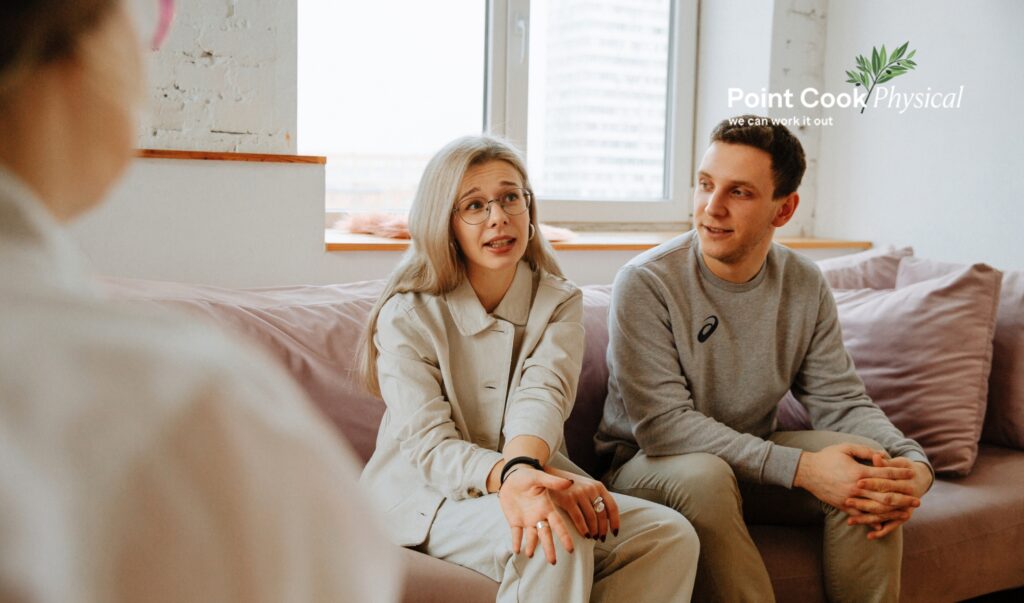
The appointment is booked. Maybe you were the one who suggested it, found a therapist and forwarded the confirmation email to your partner with a hopeful (and slightly nervous) note attached. Now the date is sitting in your calendar, and a new set of worries has crept in. What if it turns into an argument in front of a stranger? What if your partner feels ambushed?
Feeling uneasy before your first couples therapy session is very common, and a lot of that unease comes from not knowing what the hour will look like. Knowing what to expect from couples therapy takes much of the guesswork out of it. Below is a plain walk-through of the first appointment and the steps that come after it, with some notes for couples where one partner is still on the fence.
The Worries People Bring to Their First Couples Therapy Session
Most couples arrive with at least one fear they haven’t said out loud. The partner who made the booking often worries that the other person will shut down or get defensive, or that the therapist will decide the relationship is beyond repair.
The partner who agreed to come along tends to carry a different set of concerns:
- The therapist will take my partner’s side, since they made the booking.
- Everything will somehow end up being my fault.
- We’ll argue in front of a stranger and leave feeling worse.
- If we need a therapist, things must be really bad.
These worries make sense. They also rest on a picture of couples therapy that doesn’t match how sessions usually run. Some people also expect the therapist to tell them whether to stay together or separate. That isn’t the therapist’s role, and decisions about the future of your relationship stay with the two of you.
What Happens in Couples Therapy During the First Session
At Point Cook Physical, the first session is attended by both partners and generally runs between 50 and 90 minutes. The aim is to understand your relationship as it is right now, from both points of view.
A first appointment usually covers:
- introductions, and how confidentiality works in couples therapy
- what prompted you to book, and what each of you hopes might change
- each partner’s perspective, heard in turn
- your relationship history, including the good parts and what drew you together in the first place
- recurring patterns the therapist notices as you talk
- how therapy is likely to proceed, plus time for any questions you both have
You won’t be expected to have a neat summary of the problem ready. You also don’t need to agree beforehand on what the problem is. Plenty of couples disagree about exactly that, and a therapist can work with it. The terms couples therapy and couples counselling are often used interchangeably, so if you’ve been searching for what to expect at couples counselling, the process described here is the same one.
What Comes After the First Session
The first session opens a short assessment phase. Our psychologist is trained in Gottman Method couples therapy, which starts by building a full picture of the relationship before any skill-building begins. After the joint appointment, each partner attends one individual 50-minute session. This gives each of you room to talk about your own background and how you experience the relationship.
A feedback session with both partners comes next. The therapist shares what they’ve noticed about your patterns, strengths and challenges, and you agree on a plan together. Ongoing sessions after that run for 50 minutes and focus on the skills you’ve identified. Sessions are available face-to-face or via telehealth, which helps when work hours or childcare make getting to the clinic tricky.
Your Therapist Isn’t There to Pick a Winner
For a hesitant partner, this is often the most reassuring part. A couples therapist isn’t listening to two versions of events to decide which one is correct. Their focus is the interaction between you: what one person does, how the other reads it, and how each response feeds the next.
A common loop goes something like this. One partner says, “You never listen.” The other replies, “Because you’re always criticising me.” The first partner pushes harder to be heard, the second withdraws, and the cycle speeds up. Asking who started it rarely gets anywhere, because each person can point to the other’s last move. A more useful question is what keeps the cycle going, and working that out together is a big part of the early sessions.
Once a couple can name their loop (“we’re doing the pursue-and-withdraw thing again”), it stops being an accusation one partner has to defend against. It becomes a pattern the two of you can spot and interrupt as a team.
If Your Partner Is the Reluctant One
Couples rarely arrive equally enthusiastic, and the first session can still be worthwhile when they don’t. A hesitant partner doesn’t need to believe therapy will work. Being willing to find out whether it could be useful is enough to start.
If you initiated the booking, it can help to tell your partner exactly that. Let them know the therapist will want to hear their side in full, and that nobody will ask them to prove anything. Reluctance usually has a story behind it too. “We’ve had the same argument for five years and nothing changes” tells a therapist something important about the relationship, so that hesitation is worth bringing into the room instead of hiding it.
How to Prepare for Couples Therapy
There’s very little homework before a first appointment. A few small steps can still make the day feel calmer:
- Sort out the logistics early: who’s driving, who’s minding the kids, and whether you’re attending in person or by telehealth.
- Jot down a few notes if it helps, such as what prompted the booking or a recent argument that sums things up. Keep them for yourself; they aren’t a script.
- Agree not to replay the whole session in the car on the way home. Give it a day to settle.
- Bring your questions, including how confidentiality works between partners and what the individual sessions involve.
It’s fine to feel awkward, too. Most people do for the first ten minutes or so, and therapists are used to guiding couples through that part.
What Couples Therapy Can and Can’t Do
Couples therapy can give you a clearer view of your patterns, a shared language for what happens between you, and practical ways to respond differently. It won’t hand either of you a verdict, and one session isn’t expected to resolve issues that have built up over months or years. Whether it helps a particular couple depends on many things, including how engaged both partners are and what they’re hoping to change.
It also isn’t the right first step for every situation. Where there are safety concerns, such as family violence, or where one partner is managing significant mental health difficulties, a psychologist may recommend individual support first or alongside couples work. Mentioning anything like this when you book helps our psychology team point you towards the right kind of support.
Your First Couples Therapy Session: Your Questions Answered
| Question | Answer |
|---|---|
| What happens at a first couples therapy session? | Both partners attend the first session, which usually runs between 50 and 90 minutes. The therapist explains how confidentiality works, asks what prompted you to book, and hears each partner’s perspective. They’ll also learn about your relationship history and goals, outline how therapy is likely to proceed, and answer any questions you have. |
| How should I prepare for couples therapy? | Very little preparation is needed. Sort out logistics such as transport, childcare and whether you’ll attend in person or by telehealth. Some people jot down a few notes about what prompted the booking. It also helps to agree not to replay the whole session straight afterwards and to bring any questions about confidentiality. |
| What if my partner is reluctant to try couples therapy? | Partners rarely arrive equally enthusiastic, and a first session can still be worthwhile. A hesitant partner doesn’t need to believe therapy will work, only be willing to find out. It can help to reassure them that the therapist will hear their side in full and won’t ask either person to prove they’re right. |
| Will the couples therapist take sides? | No. A couples therapist isn’t there to decide who is right or who is to blame. Their focus is the pattern between you: how one partner’s words or actions affect the other, and how each response feeds the next. Understanding that cycle together is what makes it possible to change it. |
| Does couples therapy work? | Couples therapy can help partners understand their patterns, build a shared language for difficult moments and practise new ways of responding. Results vary between couples and depend on factors such as how engaged both partners are and what they hope to change. It isn’t expected to resolve long-standing issues in a single session. |